
8 Minutes Read
The Self-Sufficient Life

THE IMPERIAL LIFE
The Self-Sufficient Life:
Off-Grid and Untethered
On the quiet satisfaction of needing nothing from the grid — and everything from the country around you.
There’s a particular satisfaction in being somewhere remote and having everything you need. Not because you packed light and roughed it — but because the setup you brought is genuinely capable of sustaining you, comfortably, for as long as you want to stay.
Self-sufficiency used to mean sacrifice. It meant cold mornings, rationed water, dead devices, and a hard limit on how long you could stay before something ran out or broke down. That version of off-grid living was a test of endurance more than an enjoyment of freedom. The best of it built character. Most of it built a tolerance for discomfort that most people, reasonably, didn’t want to develop.
That calculus has changed. The technology exists now to be genuinely self-sufficient — solar power, lithium storage, efficient heating, clean water — without giving up any of the comfort that makes a week in the backcountry something to look forward to rather than endure. What matters is whether the equipment was built with that goal in mind, or whether self-sufficiency was an afterthought bolted onto a platform designed for campgrounds.
The difference between those two things is everything.
What Self-Sufficiency Actually Requires
True off-grid capability isn’t a single feature — it’s a system. Power, water, heat, and shelter have to work together, each one sized and engineered to support the others. A massive solar array connected to an undersized battery bank doesn’t solve the problem. A powerful heater running off a propane supply that only lasts two nights doesn’t either. The whole system has to be thought through, or the weakest link defines the limits of your freedom.
Power
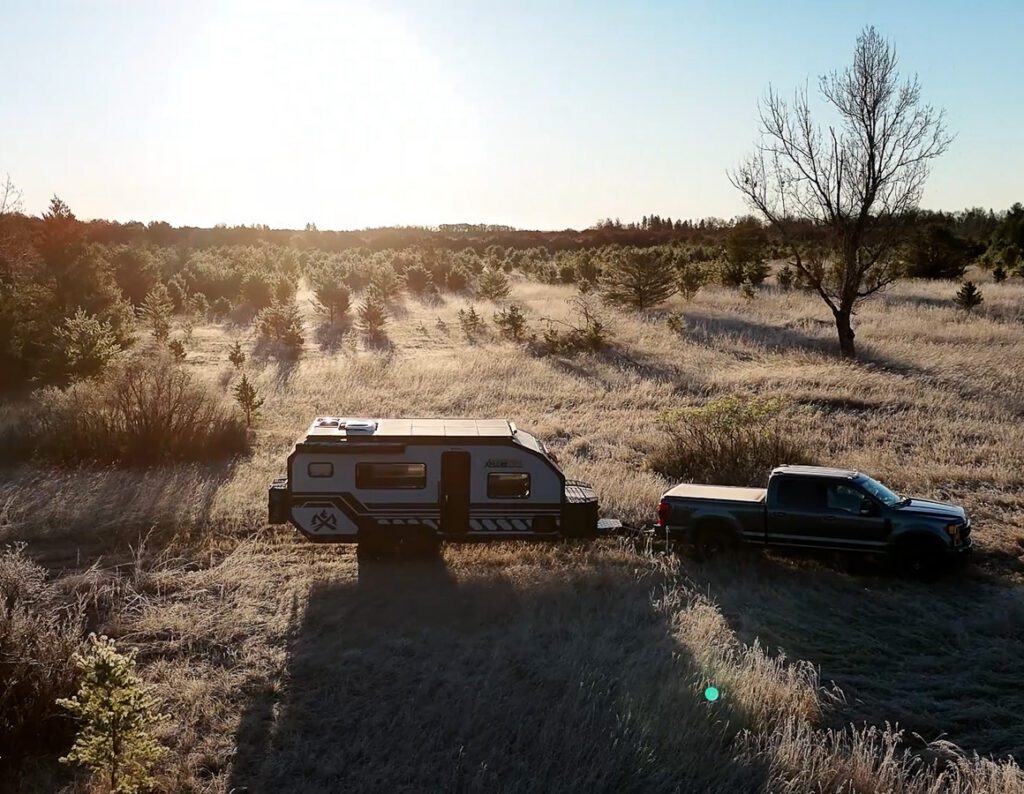
- Up to 1,240 watts of rooftop solar feeding lithium battery banks up to 1,080Ah. Enough to run lights, devices, the furnace blower, and climate control for days without needing to move or recharge from an outside source.
Water
- Heated fresh water tanks keep your supply fully functional well below freezing. Hot water on demand via the Truma Combi system — the same unit that heats the trailer — means no separate water heater drawing extra power.
Climate
- The Truma Combi furnace holds interior comfort down to −40°F. The Dometic RTX2000 air conditioner handles the other end of the spectrum, running efficiently off solar even in high-desert summer heat.
Shelter
- Nearly 3-inch thick fully insulated wall panels and a purpose-built all-season structure mean the trailer itself is doing real thermal work — not relying entirely on the heating system to compensate for poor insulation.
When all four of those systems are designed to work together — and sized for real extended use rather than a weekend — the result is a basecamp that imposes almost no limits on where you go or how long you stay. That’s the goal. Everything else follows from it.
The Freedom That Actually Matters
People talk about freedom in the outdoors in broad terms — the open road, no schedule, answering to nobody. All of that is real. But the specific freedom that off-grid capability provides is more concrete than that, and more valuable.
It’s the freedom to stay. To find a place that earns your attention and remain there for four days instead of one night, because you’re not rationing power or watching a water gauge tick toward empty. To extend a trip by a week because the fishing is exceptional and there’s no logistical reason to leave. To park five miles further down the two-track because you don’t need a hookup, and that extra five miles is the difference between a campsite someone else found and one that belongs entirely to you.
“We stayed eleven days. Not because we planned to — because nothing ran out and nothing broke down and there was no reason to leave.”
That kind of freedom requires a specific kind of confidence in your equipment. Not optimism — confidence. The knowledge, earned through experience with a capable and reliable system, that the trailer is not the limiting factor in your plans. That the country around you is the only thing setting the terms.
The Mindset That Goes With It
There’s a particular type of person who gravitates toward this life, and it’s not necessarily the person who grew up camping or who has decades of backcountry experience. It’s the person who values self-reliance as a principle. Who finds genuine satisfaction in a system that works — in knowing that the power is on because they planned the solar correctly, the water is hot because the plumbing held, the camp is comfortable because the equipment was chosen carefully.
It’s not surprising that a significant number of Imperial owners come from military backgrounds. The military instills a specific relationship with equipment — you maintain it, you trust it, and when you need it, it performs. There’s no patience for gear that almost works or systems that require workarounds. That same standard applied to a camping trailer produces a very different set of expectations than the average RV buyer brings to a dealership.
ON REDUNDANCY
Anyone who has spent serious time in remote environments — military, search and rescue, long-distance expedition — develops a deep appreciation for redundancy. A backup for the backup. Imperial trailers are designed with that mindset: heated tanks that protect the water system, a combined furnace and water heater that reduces single points of failure, and power architecture that can be expanded as your needs evolve. Capability by design, not by accident.
The retiree who spent thirty years building a business operates with a similar philosophy. They’ve learned the cost of systems that fail, the value of preparation, and the particular satisfaction of watching a well-run operation perform exactly as intended. Applied to a week in the Wyoming high country, that sensibility produces something that looks a lot like wisdom.
What Off-Grid Looks Like in Practice
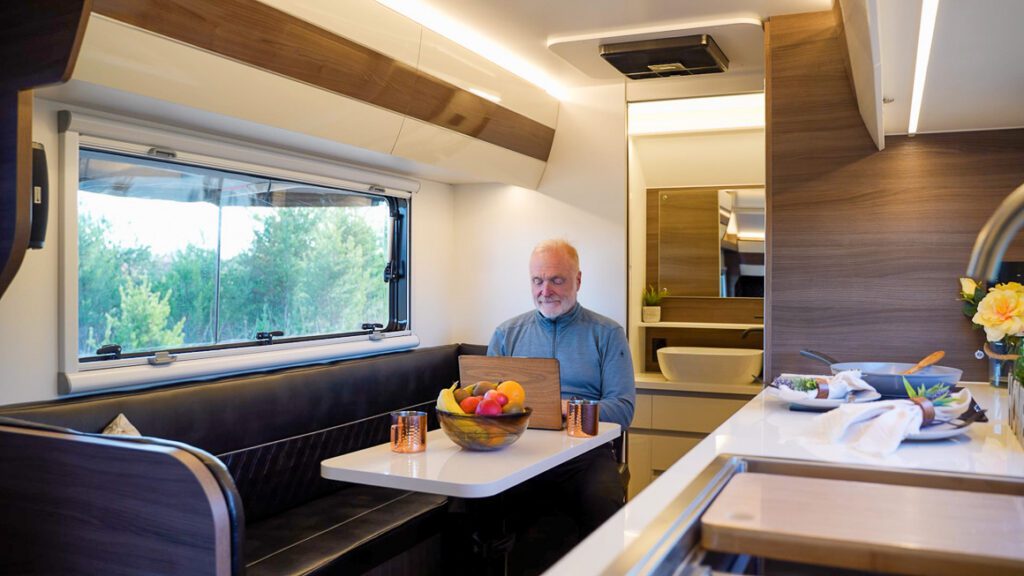
Not everyone who pursues this life does it the same way. Some couples spend two or three weeks at a time in remote country, moving slowly and staying as long as a place holds their interest. Others use the capability as insurance — knowing they could stay two weeks, so a week feels relaxed rather than rushed. A few take the long view entirely and spend most of their year on the road, using their trailer as a genuine primary residence during the traveling months.
Power – WHAT A WEEK OFF-GRID ACTUALLY DRAWS
-
LED lighting, phone and device charging, the furnace blower, occasional laptop use, and the Dometic air conditioner on warm afternoons. A properly sized lithium system handles all of this with capacity to spare, even accounting for reduced solar input on overcast days.
Water – FRESH WATER FOR TWO PEOPLE OVER A WEEK
-
Thoughtful use of a generous fresh tank — cooking, drinking, brief showers, dishwashing — extends comfortably across a week for two people without resupply. Knowing your tank capacity and your daily use takes one trip to figure out and applies to every trip thereafter.
Heat – FUEL CONSUMPTION IN REAL COLD
-
The Truma Combi is efficient by design — it heats both the space and your water from a single unit. In sustained cold, your propane consumption is real but predictable, and planning an extra supply for a long winter trip is straightforward math rather than guesswork.
The common thread across all of these use patterns is intentionality. People who live this way tend to know their systems, trust their equipment, and make decisions based on genuine capability rather than guesswork and hope. That knowledge is part of what makes the life enjoyable — the confidence that comes from understanding what you have and what it can do.
Where This Life Takes You
The honest answer is: further. Further from the trailhead, further from the campground, further from the RV park with the hookups and the neighbors twenty feet away. Further into the country that most people don’t reach because most equipment doesn’t support it.
The BLM lands of the Great Basin. The national forests of the northern Rockies. The canyon country of the Colorado Plateau. The high desert of eastern Oregon. These are not places that reward the timid or the underprepared — but they reward everyone else extravagantly. The landscape is bigger, the silence is deeper, and the sense of having genuinely earned where you are carries a satisfaction that no developed campsite can replicate.
You don’t need to be the most experienced person in the backcountry to go there. You need to be prepared. You need equipment that was built for it. And you need the willingness to go a little further down the road than most people do.
The rest takes care of itself.
Built for the people who go further.
Imperial Outdoors trailers are designed from the ground up for genuine off-grid, all-season capability — not as a feature list, but as a philosophy. If you’re ready to stop compromising between comfort and self-sufficiency, find your nearest dealer and see what’s possible.